Rust web frameworks compared
axum, Actix Web and Rocket are the best-known Rust web back-end frameworks; Leptos, Yew and Dioxus build front ends in Rust compiled to WebAssembly, while React, Vue, Svelte or Angular can sit in front of any Rust API. Ruststudio’s full-stack templates use axum with a front end of your choice.
Updated · describes Ruststudio 0.1.5
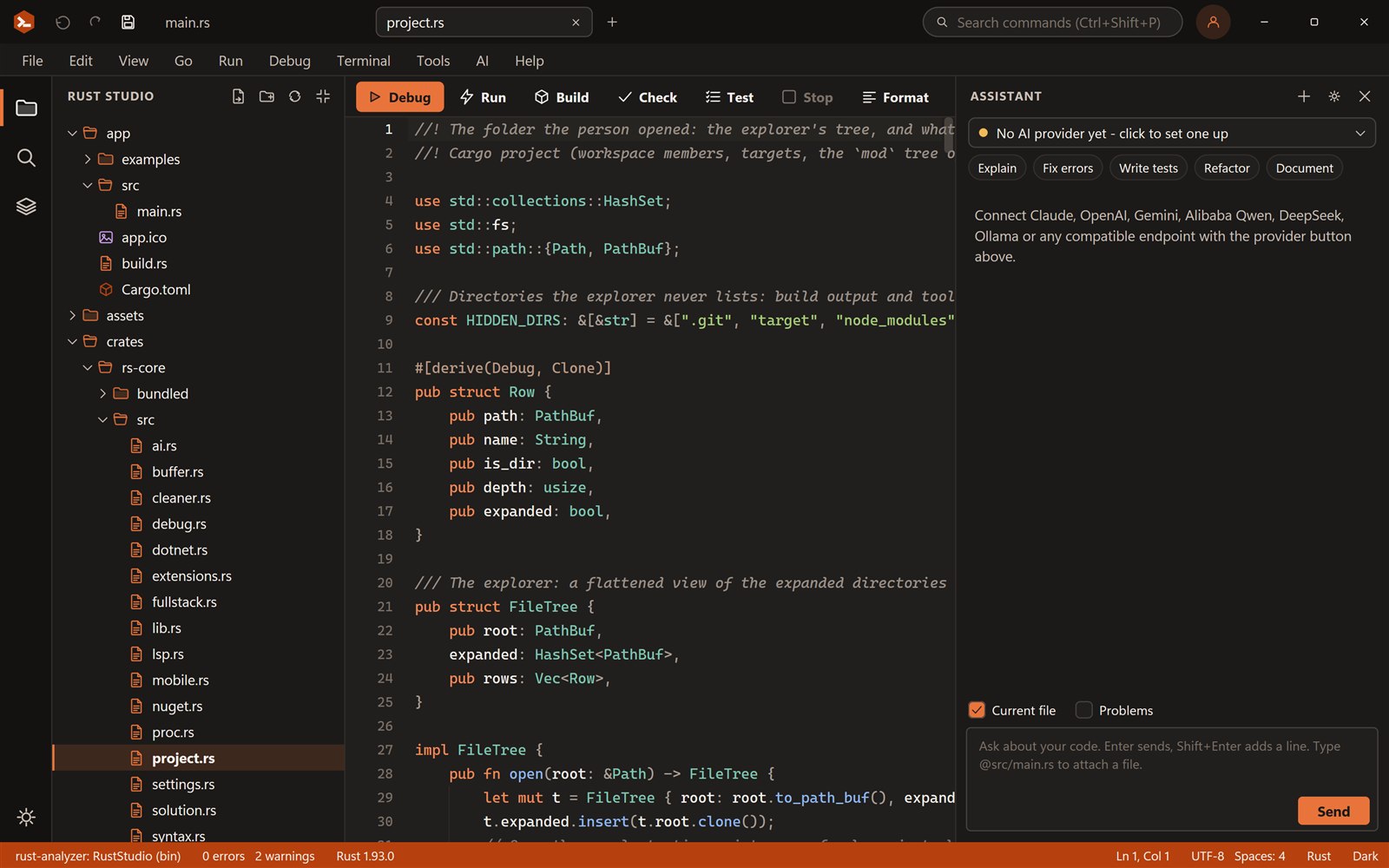
A guide to the Rust web backend and frontend frameworks, which to pick for a new project, and what a full-stack Rust setup needs from your tools.
Rust web frameworks at a glance
| Framework | Side | Notes |
|---|---|---|
| axum | Back end | Built on tokio and tower by the tokio team; routing with extractors; the most common starting point today |
| Actix Web | Back end | Mature, very fast, its own actor-based heritage; large ecosystem |
| Rocket | Back end | Ergonomic, macro-driven API with strong typing |
| Poem | Back end | Small, with built-in OpenAPI support |
| Leptos | Front end and full stack | Signals-based, server-side rendering and WebAssembly hydration |
| Yew | Front end | Component-based WebAssembly framework in the style of React |
| Dioxus | Front end and more | React-like components for web, desktop and mobile |
Back end: start with axum
For a new Rust web service, axum is a safe default: it sits on tokio and tower, composes with the rest of the async ecosystem, and has a gentle learning curve. Actix Web remains a strong, fast alternative, and Rocket appeals to people who like its macro-based style. All of them serve JSON APIs, static files and WebSockets.
Front end: Rust or JavaScript?
You can write the front end in Rust with Leptos, Yew or Dioxus, compiled to WebAssembly, or keep a React, Vue, Svelte or Angular front end and let Rust serve its API. The second route has the larger ecosystem and hiring pool; the first gives you one language and shared types end to end.
- Rust on both sides: Leptos or Yew with an axum server
- Rust API, JavaScript front end: axum with React, Vue, Svelte or Angular
- One executable at the end: embed the built front end in the server binary
The tools you need for full-stack Rust web development
You need the Rust toolchain (rustup, cargo, rust-analyzer), Node.js if the front end is JavaScript, a database driver, and a way to run the back end and the front end dev server together. Ruststudio’s web templates set this up in one click: an axum back end, a React, Vue, Svelte or Angular front end, a dev proxy for /api, and a release task that bundles the website into a single executable.
Frequently asked questions
Something else? Ask in the community forum or send feedback.
What is the best Rust web framework?
axum is the most common choice for new back ends; Actix Web and Rocket are well-established alternatives. For a Rust front end, look at Leptos, Yew or Dioxus.
Which tools and IDE do you need for full-stack Rust web development?
The Rust toolchain with cargo and rust-analyzer, Node.js for a JavaScript front end, a database driver and an editor that runs both servers. Ruststudio’s full-stack templates create an axum back end with a React, Vue, Svelte or Angular front end, a dev proxy and a one-executable release.
Is Rust good for web development?
Yes, for back ends where speed, memory use and reliability matter. For front ends it is a choice between Rust compiled to WebAssembly and a JavaScript framework talking to a Rust API.
Axum or Actix Web?
Both are production-ready. axum integrates tightly with tokio and tower and is a popular default; Actix Web has a long track record and very high throughput. Pick the one whose API you prefer.
Can a Rust web app be one executable?
Yes. Build the front end, then compile it into the server binary, so one file serves both the website and the API. Ruststudio’s web templates have a task for it.